
IMPRUV Insight | Research Integrity | October 2026
When Questionable Research Becomes Accepted Evidence
Published
Could AI help detect manufactured scientific consensus before it influences research, medicine, or regulation?
Abstract
A 2026 study published in The BMJ used machine learning to screen more than 2.6 million cancer research papers and flagged 261,245, or 9.87%, because their titles and abstracts shared textual characteristics with known retracted paper-mill publications. A flag does not establish fraud. It does, however, raise a larger question. What happens when unreliable research is subsequently cited, incorporated into systematic reviews, or eventually treated as established evidence? And if an accumulation of questionable evidence were ever intentional, could artificial intelligence help identify the pattern?
Highlights
- The BMJ model screened 2,647,471 original cancer research papers published between 1999 and 2024 and flagged 261,245 based on textual similarity to retracted paper-mill publications.
- The model reported an accuracy of 0.91, but classification is a screening signal, not proof that an individual paper was fabricated.
- Separate research examining 200,000 systematic reviews found 299 that incorporated at least one retracted paper-mill article into their evidence synthesis.
- Of 385 citations to those retracted articles, 124 occurred after retraction. Oncology was the most affected research area in that analysis.
- These findings raise a broader possibility for AI: evaluating not only individual publications, but also the integrity of the evidence networks that connect them.
Introduction
Science builds on science.
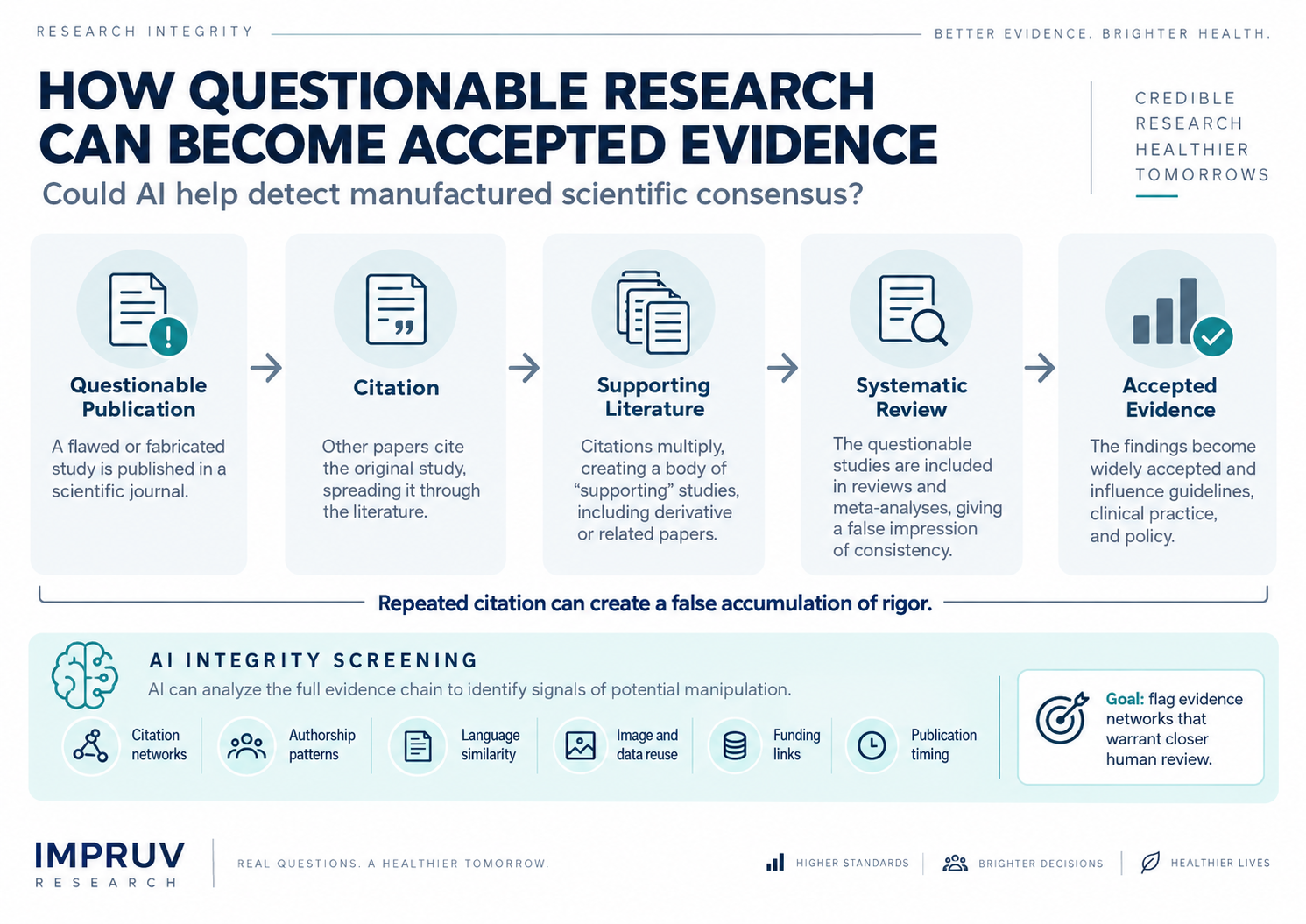
One study becomes a citation. Citations support new hypotheses. Multiple studies may become systematic reviews and meta-analyses. Those analyses can influence clinical practice, future research, product development, and regulatory strategy.
That process depends heavily on the reliability of the evidence entering the chain.
What happens when that foundation is questionable?
Materials and Methods
This IMPRUV Insight reviewed the 2026 BMJ study on machine-learning screening of potential paper-mill publications, published responses concerning limitations of the classifier, a 2025 JAMA Network Open study examining citation contamination in systematic reviews, and FDA information concerning unreliable data in medical-device submissions.
The BMJ classifier examined textual characteristics in article titles and abstracts. Its results are therefore treated here as risk signals requiring possible investigation, not determinations of fraud. Published responses have also raised questions about specificity, false-positive rates, and possible linguistic or geographic bias.

Discussion
The larger risk may begin after publication
A questionable publication does not necessarily remain isolated.
A researcher may cite it without knowing that its underlying evidence is unreliable. Another publication may then cite both papers. Over time, several apparently independent publications can appear to support the same conclusion.
The result could become a false accumulation of rigor.
The downstream researchers may have acted entirely in good faith. Yet repeated citation can give unreliable evidence an appearance of legitimacy it did not originally deserve.
This concern is not purely theoretical. The JAMA Network Open analysis found 299 systematic reviews that incorporated retracted paper-mill articles into their evidence synthesis. The authors concluded that such contamination can threaten the validity of evidence synthesis and potentially affect downstream research and clinical practice.
What if the accumulation were intentional?
A more difficult scenario deserves consideration.
What if questionable studies were deliberately introduced into the scientific literature and subsequently reinforced through additional publications, citations, reviews, or analyses?
The objective could theoretically be to create the appearance of independent scientific support where genuine independent confirmation did not exist.
The BMJ study provides no evidence that such coordinated manipulation occurred.
But the possibility raises an important research-integrity question:
Could scientific literature ever be intentionally engineered to create the appearance of consensus?
If the answer is even potentially yes, identifying one questionable paper may not be enough.
Could AI examine the evidence network?
AI may eventually help identify patterns that are difficult to recognize when publications are reviewed individually.
An integrity-screening system could examine:
Citation networks: Are supposedly independent papers repeatedly reinforcing the same unusual cluster?
Authorship and institutional relationships: Do the same people, laboratories, contractors, or organizations repeatedly appear behind apparently independent evidence?
Language similarity: Are distinctive methods, descriptions, or conclusions reused across unrelated publications?
Image and data reuse: Do supposedly independent studies contain suspiciously similar figures, images, patient data, or statistical distributions?
Funding relationships: Are undisclosed common financial interests connecting the publications?
Publication timing: Do supportive publications appear in unusual concentrations around commercial or regulatory milestones?
No single signal proves misconduct.
Together, however, such signals could help identify an evidence network that warrants closer human review.
Why this matters beyond publishing
The implications extend into regulated healthcare.
FDA has warned medical-device manufacturers about fabricated, duplicated, and otherwise unreliable third-party testing data appearing in premarket submissions. The agency states that manufacturers are responsible for ensuring that information submitted to FDA is truthful and accurate and for independently assessing third-party data.
There is an important distinction between unknowingly relying on questionable literature and knowingly presenting unreliable information.
That distinction makes evidence verification increasingly important.
IMPRUV Perspective
The next frontier in research integrity may not simply be detecting a fraudulent paper.
It may be identifying when multiple publications combine to create a misleading appearance of evidence.
AI should not determine whether misconduct occurred. But it may become increasingly valuable for identifying relationships, inconsistencies, and unusual patterns that deserve investigation.
The objective is not automated judgment.
It is better verification.
Conclusion
The BMJ study does not prove that 261,245 cancer research papers were fabricated.
It demonstrates that machine learning can identify a substantial body of literature sharing textual characteristics with known paper-mill publications.
The more consequential issue may be what happens afterward.
If unreliable evidence is repeatedly cited and incorporated into increasingly authoritative forms of scientific synthesis, its influence may extend far beyond the original publication.
Research integrity may therefore require us to evaluate not only individual studies, but the integrity of the evidence chain itself.
Closing Thought
“The idea is to try to give all of the information to help others to judge the value of your contribution.”
Richard P. Feynman, Nobel Laureate in Physics
Feynman made this statement while discussing scientific integrity in his 1974 Caltech commencement address.
IMPRUV Commitment
IMPRUV Research supports publication and evidence-development efforts grounded in verifiable source data, transparent methodology, and responsible interpretation. We use AI-assisted review to help identify inconsistencies, questionable citation patterns, source concerns, and other signals that may warrant additional verification, while keeping human review and final judgment central to the process.
Our objective is not to use AI to declare what is true, but to help determine what deserves a closer look before evidence is published, cited, or relied upon.