
IMPRUV Insight | Clinical Research | October 2026
Can Clinical Trials Move Faster Without Compromising the Evidence?
A closer look at ARPA-H's SURPASS program and what it may signal for the future of clinical research.
Abstract
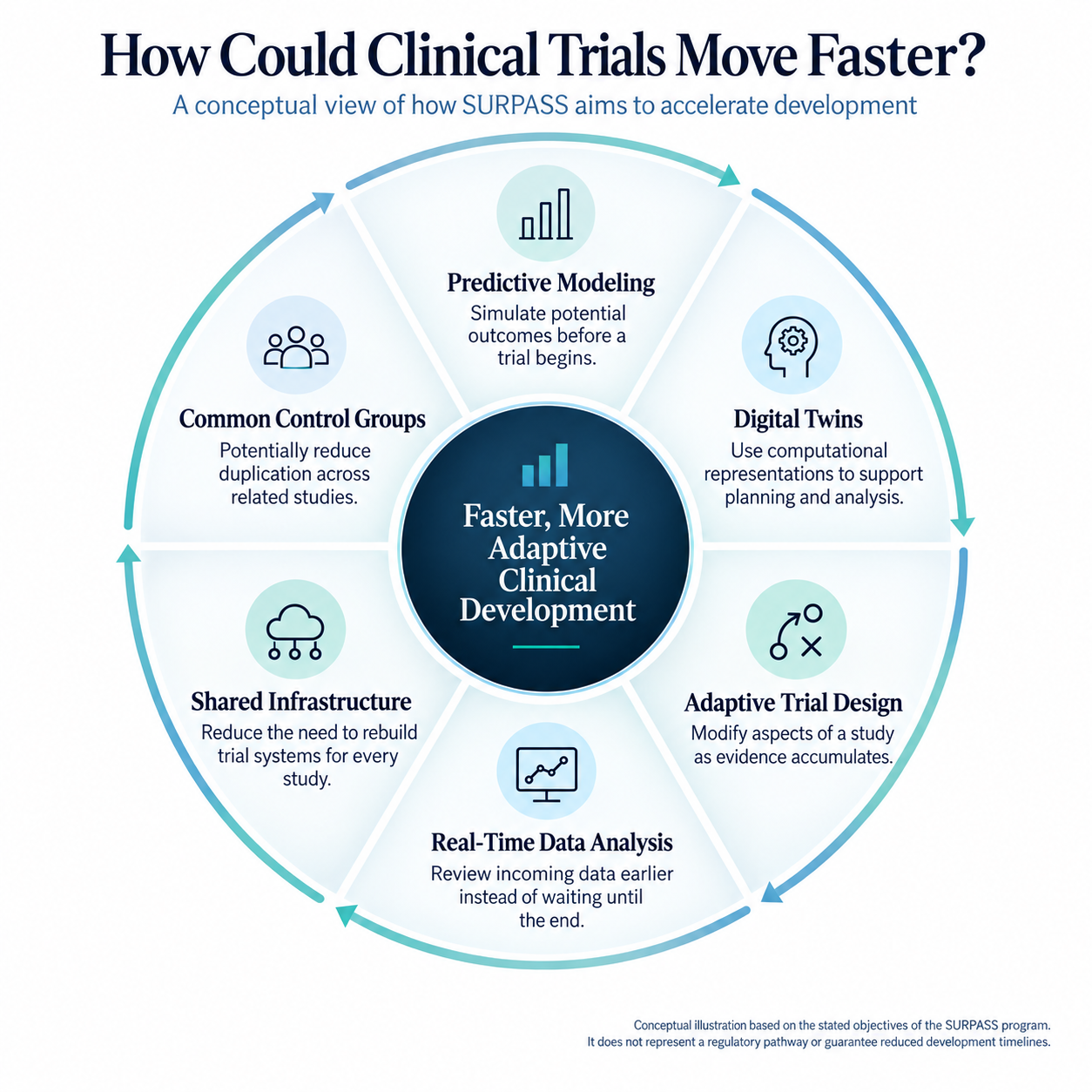
Clinical development can take more than a decade, involve substantial expense, and still result in failure. On September 30, 2026, the U.S. Department of Health and Human Services, through the Advanced Research Projects Agency for Health, announced SURPASS. The program is designed to explore whether computational modeling, adaptive trial structures, shared infrastructure, common controls, automation, and real-time analysis can accelerate clinical development. The opportunity is compelling. The more important question may be whether greater speed can be achieved while preserving the rigor, transparency, and confidence expected of clinical evidence.
Highlights
- SURPASS asks whether clinical development that can take more than a decade could ultimately be shortened to less than four years.
- The program proposes predictive computational models and digital twins to support trial planning and analysis.
- Real-time analysis and adaptive trial methods are intended to enable earlier, more informed decisions as evidence accumulates.
- Shared infrastructure and common control groups are intended to reduce duplication and repeated trial startup work.
- ARPA-H is exploring whether these approaches could reduce time, cost, and participant burden while improving decision making.
Introduction
Clinical research has traditionally required a difficult balance among scientific rigor, patient protection, operational practicality, cost, and time. SURPASS asks whether that balance can be improved. Rather than simply accelerating existing processes, the initiative proposes changing aspects of how trials are planned, conducted, analyzed, and adapted as information becomes available. That represents a potentially important shift. It also creates a new set of questions.
Materials and Methods
This IMPRUV Insight reviewed primary source material published by HHS and ARPA-H concerning the launch, objectives, and proposed mechanisms of the SURPASS program. The review focused on predictive computational modeling, digital twins, adaptive platform trial design, real-time analysis, shared infrastructure, and common controls. Statements describing SURPASS are based on official source material. The Discussion and IMPRUV Perspective sections represent interpretation and questions raised by those materials.
Discussion
Faster is attractive. Is faster sufficient?
The benefits of shortening clinical development are easy to recognize. Effective therapies could potentially reach patients sooner. Sponsors could identify unsuccessful programs earlier. Research infrastructure could be used more efficiently. Yet speed is not ultimately what determines the value of clinical research. Confidence in the resulting evidence does.
If computational models begin influencing trial design, the assumptions behind those models become increasingly important. If trials adapt as information accumulates, researchers must determine when adaptation strengthens a study and when it could complicate interpretation.
One question worth considering is this: When does technology improve the evidence, and when does it simply accelerate the process that produces it?
Could the researcher's role change?
Automation may reduce repetitive operational work and identify patterns more quickly. But identifying a pattern is not the same as understanding its importance. A signal may still require a researcher to ask whether it is biologically plausible, clinically meaningful, reproducible, and relevant to the intended population. Technology may change the researcher's role without diminishing the need for scientific judgment.
More data or better evidence?
Modern research technologies can generate extraordinary quantities of information. Historically, researchers often asked how to obtain enough data to answer the question. Increasingly, the challenge may be deciding which of all the available data actually answers the question.
IMPRUV Perspective
SURPASS is noteworthy not simply because it seeks faster trials, but because it challenges assumptions about how clinical research must be conducted. Some traditional processes exist because they protect scientific integrity. Others may persist primarily because research has historically been organized that way. Understanding the difference could prove important. The opportunity may not be to choose between traditional research and technology-enabled research, but to determine where technology can improve efficiency while preserving the principles that make clinical evidence trustworthy.
Conclusion
Whether SURPASS ultimately achieves its objectives remains to be demonstrated. However, the questions it raises are already valuable. Can trials become faster without becoming less rigorous? Can computational models supplement human evidence without obscuring uncertainty? Can automation reduce unnecessary work while preserving scientific judgment? Most importantly, can innovation help us produce not merely more evidence, but better evidence?
References
- U.S. Department of Health and Human Services. HHS Launches SURPASS and New Efforts to Accelerate Faster, Smarter Clinical Trials. September 30, 2026. https://www.hhs.gov/press-room/hhs-arpa-h-launch-surpass-modernize-clinical-trials.html
- Advanced Research Projects Agency for Health. SURPASS: Simulation-augmented, Real-time Platform Adaptive Seamless Trials. https://arpa-h.gov/explore-funding/programs/surpass
- Curie M. Pierre Curie. Macmillan, 1923. Public-domain text via Project Gutenberg. https://www.gutenberg.org/ebooks/69617
Closing Quote
“I am among those who believe with Nobel that humanity will obtain more good than evil from future discoveries.”
Pierre Curie