
IMPRUV INSIGHT · SURGICAL ROBOTICS
FDA and Robotic Medical Devices: What Manufacturers Should Know
Published
Abstract
FDA’s September 2026 draft guidance describes evidence recommended for certain robotically-assisted surgical devices. A separate December workshop will address autonomous and remote operation. Manufacturers need to distinguish accurate device operation from appropriate clinical decisions and improved patient outcomes. Accurate execution alone does not establish appropriate planning. This article reviews the FDA documents and a randomized surgical trial, then considers how studies could evaluate planning, surgeon intervention, safety, and clinical benefit as artificial intelligence takes a greater role in surgery.
Highlights
- The September guidance is a draft with nonbinding recommendations. [1]
- Remote telesurgery and significant independent operative activity are outside its scope. [2]
- FDA’s December 2–3 workshop concerns autonomous and remote operation. [3]
- In iROC, a statistically significant recovery difference had uncertain clinical importance. [4]
Short Introduction
Robotic surgery studies should identify what the device does, what the surgeon decides, and which outcomes support the proposed use. These distinctions matter when interpreting results from supervised procedures and considering greater autonomy.
Materials and Methods
This narrative review used FDA documents and the peer-reviewed iROC trial. It is not a systematic review or patient-level reanalysis. The Discussion identifies IMPRUV’s interpretation and proposed study measures.
The Claim vs. The Evidence
The draft addresses nonclinical testing, clinical evidence, and labeling. It is not for implementation. FDA requests comments by November 24, 2026. [1] Proposed clinical measures include hospital stay, adverse events, conversion, readmission, reoperation, mortality, and operative time. [2]
The 2022 iROC trial randomized 338 patients; 317 underwent cystectomy and 305 contributed to the primary analysis. Median days alive and outside hospital within 90 days were 82 after robotic surgery versus 80 after open surgery. The adjusted difference was 2.2 days (95% CI, 0.50–3.85; P=.01). Clinical importance remained uncertain. [4]
Safety Findings
FDA cautions that surgical-device incident reports can be incomplete or duplicated and do not independently establish causation. [5] IMPRUV recommends reporting AEs and SAEs with denominators, timing, attribution, deaths, and interventions. Severity concerns intensity; seriousness concerns outcomes such as death or hospitalization. [7]
Study Limitations
iROC reported unblinded care, pandemic disruption, high-volume centers, and limited oncological follow-up. Its original calculation targeted 80% power for a two-day difference, followed by a blinded recalculation. That does not establish power for rare harms. [4]
Risk of Bias and Reporting Completeness
iROC disclosed manufacturer-supplied consumables and investigator financial relationships; secondary analyses were exploratory. [4] This review did not independently reconcile all supplements, protocols, or safety events. No numeric IRRS score is assigned.
Discussion: IMPRUV Perspective
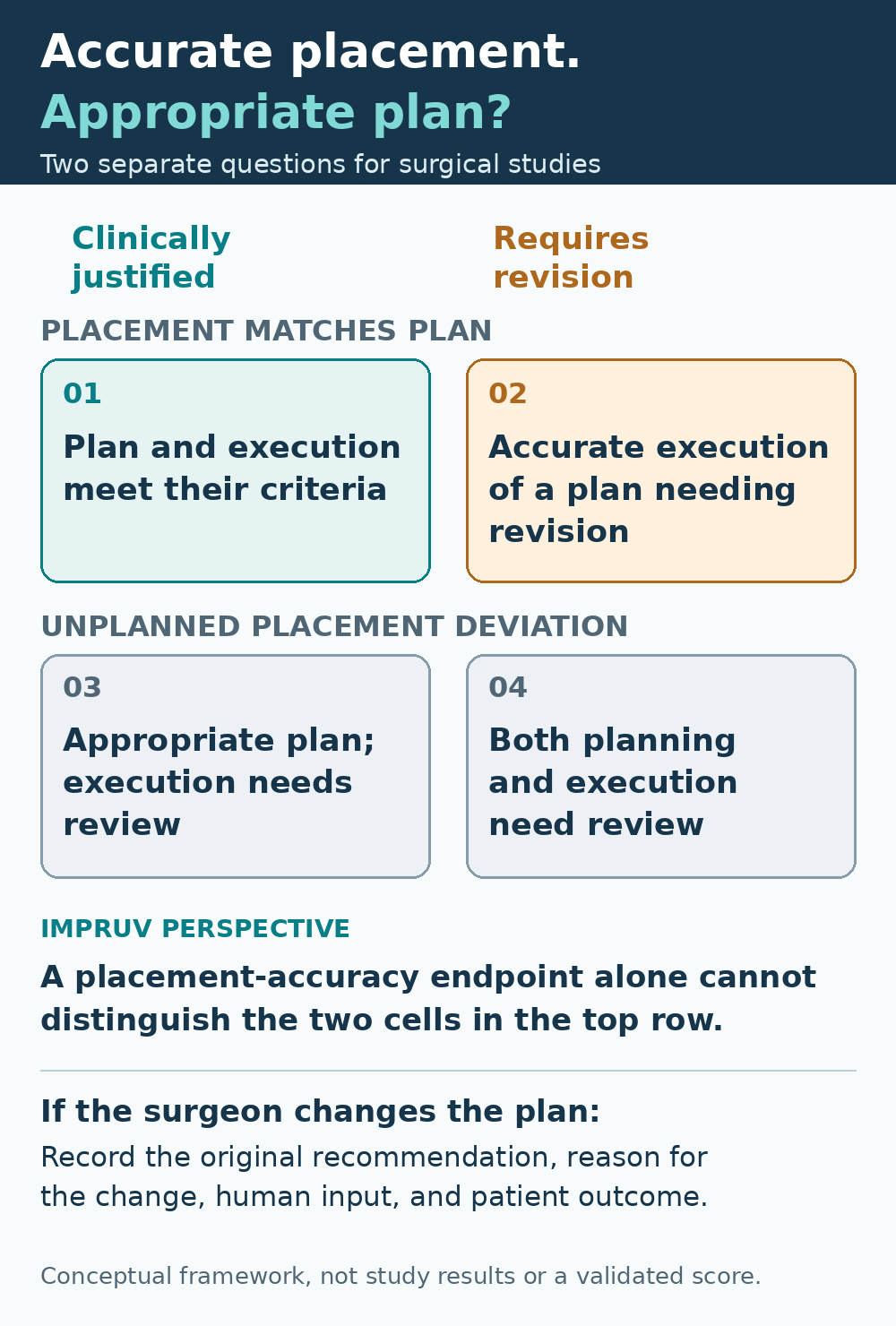
IMPRUV considers planning quality and placement accuracy separate study questions. A device can accurately execute a plan that provides acceptable fixation without establishing whether a different plan would provide better fixation for that patient.
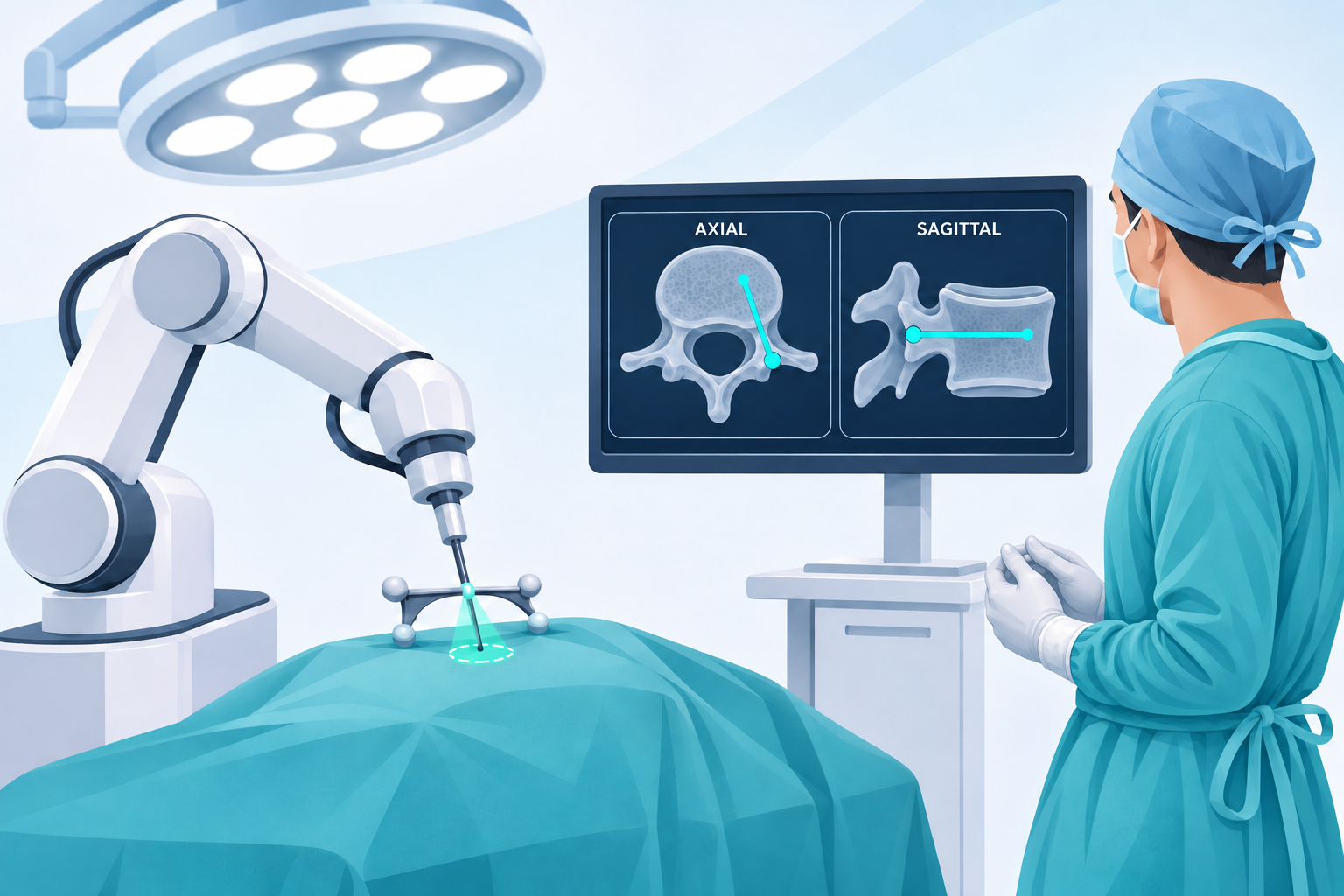
Consider a hypothetical spinal procedure. A robotic surgical platform with AI-assisted planning software selects a pedicle screw measuring 5.5 mm in diameter and 40 mm in length and guides its placement. A surgeon, using conventional measurement, pedicle probing, and intraoperative guidance or monitoring, proposes a 6.5 mm diameter, 50 mm long screw to obtain stronger purchase, potentially including bicortical fixation. The example does not establish that either selection is preferable. Anatomy, bone quality, cortical integrity, and surrounding structures must be assessed. A larger or longer screw is not automatically the safer or more effective choice.
If the study records only agreement between planned and achieved placement, it cannot resolve this comparison. IMPRUV recommends independent clinical review of the proposed dimensions and trajectory, with reasons recorded for accepting or changing the plan. Surgeon preference should be evaluated rather than treated as an unquestioned reference standard. Appropriate biomechanical testing could examine fixation performance; clinical follow-up should assess loosening, fusion, revision, neurological outcomes, pain, and function.
Surgeon intervention also needs separate reporting. When the surgeon changes the screw size, corrects a trajectory, or takes over a task, the final result reflects both the device and the clinician. IMPRUV recommends recording the original recommendation, the intervention, its reason, and the resulting outcome. This would help identify which decisions the device performs adequately and where human judgment remains necessary.
Early feasibility studies address initial safety and proof of principle. FDA states that they require an appropriate benefit-risk analysis and subject protections. [8] Their early stage alone does not justify avoidable harm or a wider anatomical error tolerance. A statistically justified noninferiority margin concerns a defined outcome comparison; it does not authorize unsafe placement in an individual patient. Adequacy for a participant requires clinical judgment within the study’s safeguards, even when the procedure meets its technical endpoint.
Manufacturers fund validation, hospitals bear acquisition and operating costs, and patients bear procedural risk. Economic assessment should include maintenance, training, staffing, consumables, downtime, complications, and revisions. Fewer hospital days alone cannot establish net savings. Evidence from experienced teams also needs assessment before assuming comparable performance in less experienced centers.
Opportunity
IMPRUV sees a research opportunity in evaluating AI-assisted decisions before expanding independent execution. Future agentic AI could compare plans, incorporate intraoperative findings, explain uncertainty, and request assistance. Studies could test these functions against defined clinical decisions while retaining surgeon oversight, then evaluate greater autonomy where supported.
These are proposed capabilities, not demonstrated benefits. Describing a system as “superintelligent” does not establish clinical competence. FDA’s December workshop provides a forum for discussing benefit and risk, not authorization. [3] Research should determine whether added intelligence improves decisions and patient outcomes, including when the system encounters unfamiliar anatomy or conflicting information.
Conclusion
Manufacturers should demonstrate what the robot contributes and report the human input needed to achieve the result. IMPRUV calls for comparative studies of autonomous robotic procedures versus procedures performed by surgeons without robotic assistance, using comparable patients, procedures, and follow-up. Studies should assess planning, execution, complications, patient outcomes, and costs, with surgeon intervention in the autonomous group reported separately.
Verified References
1. FDA. Robotically-Assisted Surgical Devices: Premarket Submissions. Draft guidance landing page, September 2026. Status and comment deadline checked November 3, 2026.
https://www.fda.gov/regulatory-information/search-fda-guidance-documents/robotically-assisted-surgical-devices-premarket-submissions
2. FDA. Robotically-Assisted Surgical Devices: Premarket Submissions. Draft text, September 2026. Scope, PDF pages 6–7; clinical evaluation, PDF pages 38–41.
https://www.fda.gov/media/194987/download
3. FDA. Public Workshop: Evaluating Benefit-Risk in Robotic Medical Devices with Autonomous or Remote Teleoperation Capabilities. Scheduled December 2–3, 2026.
https://www.fda.gov/news-events/fda-meetings-conferences-and-workshops/public-workshop-evaluating-benefit-risk-robotic-medical-devices-autonomous-or-remote-teleoperation
4. Catto JWF, Khetrapal P, Ricciardi F, et al. Effect of Robot-Assisted Radical Cystectomy With Intracorporeal Urinary Diversion vs Open Radical Cystectomy on 90-Day Morbidity and Mortality Among Patients With Bladder Cancer: A Randomized Clinical Trial. JAMA. 2022;327(21):2092–2103. Published online May 15, 2022. doi:10.1001/jama.2022.7393.
https://jamanetwork.com/journals/jama/fullarticle/2792543
5. FDA. Computer-Assisted Surgical Systems. Current agency information reviewed November 3, 2026.
https://www.fda.gov/medical-devices/surgery-devices/computer-assisted-surgical-systems
6. Feynman RP. Cargo Cult Science. Caltech commencement address, 1974, archived by Caltech.
https://calteches.library.caltech.edu/51/2/CargoCult.htm
7. FDA. What is a Serious Adverse Event? Current safety-reporting information reviewed November 3, 2026.
https://www.fda.gov/safety/reporting-serious-problems-fda/what-serious-adverse-event
8. FDA. Investigational Device Exemptions (IDEs) for Early Feasibility Medical Device Clinical Studies, Including Certain First in Human (FIH) Studies. Final guidance, October 2013. Reviewed November 3, 2026.
https://www.fda.gov/regulatory-information/search-fda-guidance-documents/investigational-device-exemptions-ides-early-feasibility-medical-device-clinical-studies-including
9. AO Foundation. Pedicle screw insertion in the lumbar spine. AO Surgery Reference. Trajectory and anatomical orientation reviewed November 3, 2026. Used as an anatomical reference; publisher artwork was not reproduced.
https://surgeryreference.aofoundation.org/spine/basic-technique/pedicle-screw-insertion-in-lumbar-spine
Closing Quote
“The first principle is that you must not fool yourself”
Richard P. Feynman, excerpt from Cargo Cult Science, Caltech’s 1974 commencement address. [6]
Related Reading
Can AI Help Design a More Informative Clinical Trial at Lower Cost?
Subscribe
Subscribe to IMPRUV Clinical Research Insights via RSS.
Keywords
robotic medical devices; FDA draft guidance; robotically-assisted surgery; clinical evidence; autonomous medical devices; remote teleoperation; adverse events; statistical power; health economics; research transparency