IMPRUV INSIGHT · CLINICAL RESEARCH · OCTOBER 23, 2026
Can AI Help Design a More Informative Clinical Trial at Lower Cost?
Published

Abstract
Before enrolling the first participant, sponsors commit resources to assumptions about recruitment, treatment effects, and the number of patients needed. Artificial intelligence could help teams examine those assumptions earlier. Published evaluations demonstrate useful performance in patient eligibility assessment, although efficiency gains vary across implementations. Predictive models also raise questions about trial outcomes and statistical precision. The opportunity extends beyond reducing expenses: resources saved could support longer follow-up, broader participation, and independent validation. Which applications can deliver those benefits, and how should research teams decide where to reinvest?
Highlights
- TrialGPT reported 87.3% eligibility-assessment accuracy and 42.6% less screening time in its evaluation. [1]
- A separate 2026 study improved prescreening accuracy with AI assistance but found essentially unchanged review time. [2]
- FDA’s final guidance discusses statistical efficiency from baseline covariate adjustment but explicitly excludes machine-learning methods from its scope. [3]
Introduction
A clinical trial can finish without answering its primary question. Recruitment may fall short, outcomes may vary more than expected, or the study may be too small to detect the treatment effect it was designed to investigate.
Could AI help research teams examine those risks before the spending begins?
Materials and Methods
This commentary reviewed primary studies on trial matching and AI-assisted prescreening, together with FDA guidance. It is a focused review, not a systematic assessment. Published results are distinguished from IMPRUV interpretation and hypothetical calculations.
Discussion
Three applications, three different questions
AI can support several research tasks, but their results mean different things:
| Application | Question |
|---|---|
| Trial-outcome forecasting | How likely is the trial to meet a defined measure of success? |
| Patient eligibility assessment | Does this patient meet the trial’s criteria? |
| Prognostic modeling | Can baseline information help explain differences in patient outcomes? |
Success in one task does not establish success in another.
What has AI demonstrated?
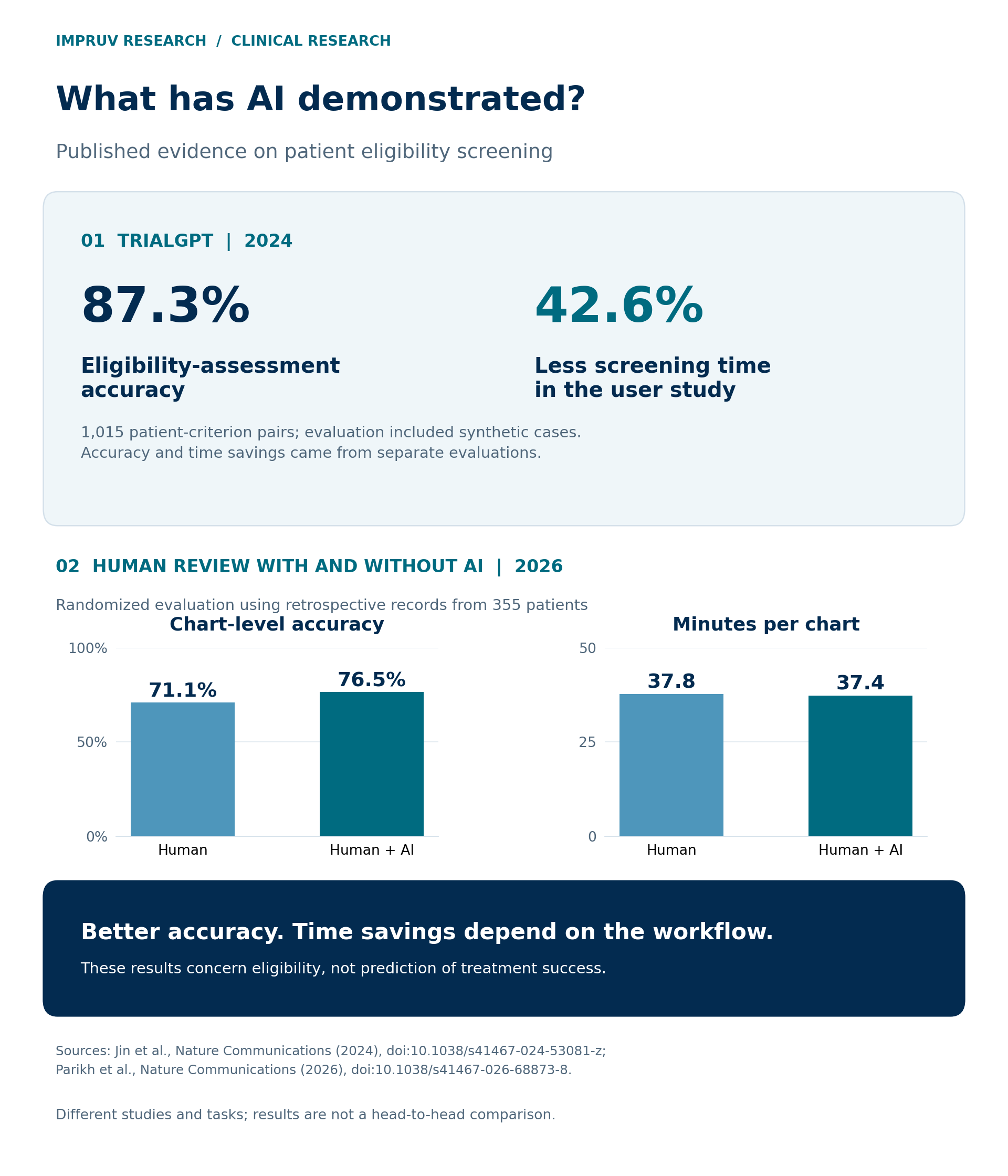
TrialGPT reported 87.3% accuracy across 1,015 patient-criterion pairs and a 42.6% screening-time reduction in its user study. Its evaluation included synthetic patient cases. These findings support further investigation of recruitment assistance, rather than a claim that AI predicts treatment success with 87.3% accuracy. [1]
A 2026 randomized evaluation using retrospective records from 355 patients illustrates why implementation matters. Chart-level accuracy improved from 71.1% with human review to 76.5% with human plus AI. Average review time remained similar: 37.8 versus 37.4 minutes. [2]
Where could the economic benefit arise?
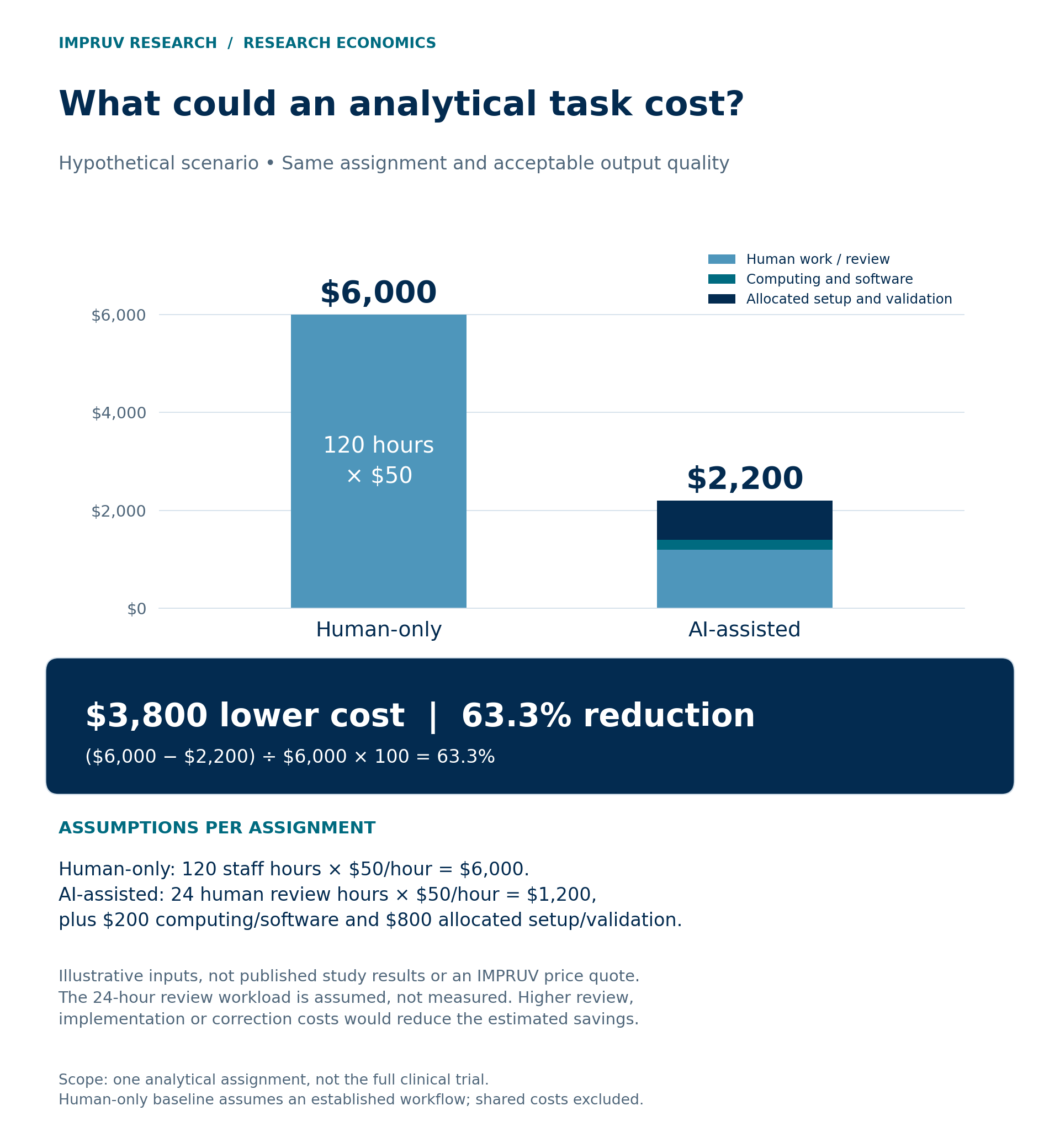
Reduced screening work could release staff time for difficult eligibility decisions and participant coordination. Computational analysis could also make it practical to compare more enrollment targets, dropout assumptions, and follow-up periods before selecting a design.
Sponsors should compare total costs: data preparation, software, computing, integration, validation, human review, and correction of errors. Cheap computation produces savings only when the complete workflow delivers reliable work at lower cost.
Could better predictions improve statistical power?
Power is the probability of detecting a specified treatment effect if that effect exists. It is not the probability that a treatment works.
Traditional software already calculates power. AI’s possible contribution is better prognostic information or support for exploring design assumptions.
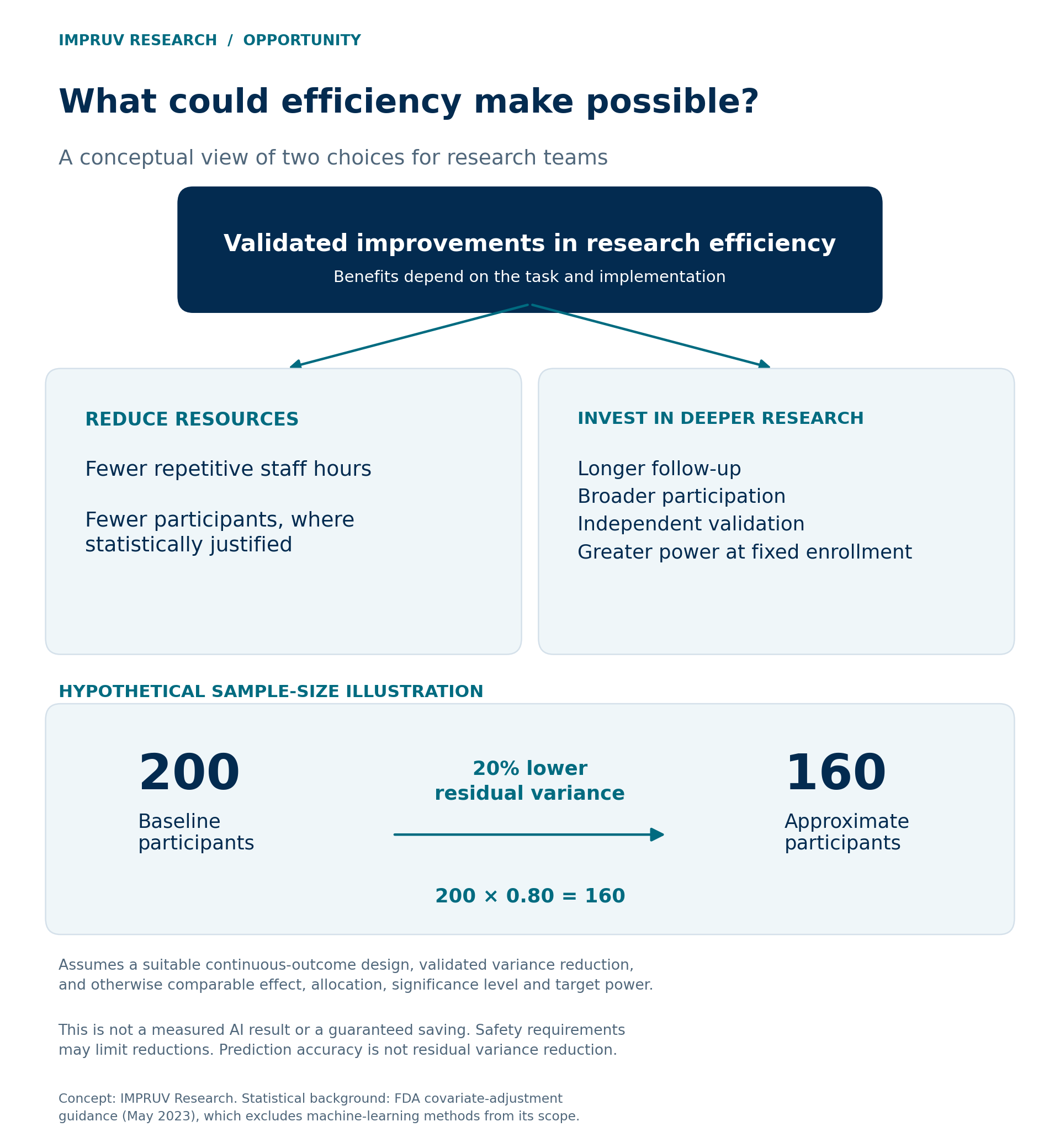
For certain continuous-outcome designs, required sample size is approximately proportional to residual variance, the variability remaining after adjustment.
In a hypothetical illustration, a baseline design requiring 200 participants could require approximately 200 × 0.80 = 160 participants if a validated analysis reduces residual variance by 20%.
This approximation assumes comparable treatment effects, significance thresholds, allocation, and target power. Retaining 200 participants could instead improve power.
The reduction must be established for the intended population and analysis. Prediction accuracy does not translate directly into sample-size savings, and safety assessment may require additional participants. FDA’s final guidance supports appropriate baseline covariate adjustment but does not address machine-learning adjustment methods. [3]
Opportunity
What could we investigate that we currently cannot afford?
If validated methods lower costs or improve precision, sponsors can choose to investigate more thoroughly.
Savings could support longer follow-up, additional sites, broader participation, or independent confirmation. Researchers could examine competing explanations and test whether findings withstand less favorable assumptions.
Smaller developers and research groups might bring previously unaffordable questions to a meaningful test. Research sites could redirect effort toward participants and complex cases.
More analyses, however, increase opportunities for false-positive findings. Additional endpoints and subgroup questions require suitable planning, sufficient data, and appropriate statistical control.
What important research could greater efficiency make possible? That question deserves a place beside the savings calculation.
IMPRUV Perspective
The strongest use of AI may connect an earlier warning with a better research decision. FDA’s AI draft guidance emphasizes model credibility within a defined context of use; it remains draft and nonbinding. [4]
Sponsors should identify the decision, establish acceptable performance, and measure the full workflow before relying on projected benefits.
Conclusion
AI has demonstrated useful performance on defined clinical research tasks. Whether that translates into lower costs or stronger evidence depends on the application and its validation.
Research teams should evaluate both what they can save and what those resources could help them discover.
References
- Jin Q, et al. Matching patients to clinical trials with large language models. Nature Communications. 2024. Study | NIH summary.
- Parikh RB, et al. Human-AI teaming to improve accuracy and efficiency of eligibility criteria prescreening for oncology trials: a randomized evaluation trial using retrospective electronic health records. Nature Communications. 2026. Source.
- FDA. Adjusting for Covariates in Randomized Clinical Trials for Drugs and Biological Products. Final guidance, May 2023. Source.
- FDA. Considerations for the Use of Artificial Intelligence To Support Regulatory Decision-Making for Drug and Biological Products. Draft guidance, January 2025. Source.
- Institut Pasteur. The Institut Pasteur in 2018: A legacy of excellence. Closing quotation source. Source.
Closing Quote
“Chance favors invention only for minds prepared for discoveries by patient study and persevering efforts.”
Louis Pasteur, as quoted by Institut Pasteur. [5]